
A client called me a few months back, convinced his email program was broken. Open rates were flat, his sales team was complaining about dead contacts, and his cost per lead kept climbing even though the budget hadn’t changed. The problem wasn’t his subject lines or his send times. It was his list. Roughly a third of the contacts he’d bought two years earlier no longer existed in any usable form — people had changed jobs, companies had merged, domains had gone dark. He was paying full price to email a graveyard.
That’s the pattern I see over and over in this business. Marketers assume the expensive part of email is the platform, the design work, or the copywriting. It isn’t. The expensive part is sending to people who were never going to open the email in the first place.
The Real Cost of an Unverified List
Every bounced email costs you twice. First, there’s the direct waste — you paid for that contact, and it produced nothing. Second, and this is the part people underestimate, a high bounce rate damages your sender reputation with Gmail, Outlook, and every other major inbox provider. Once your domain gets flagged as a source of undeliverable mail, providers start routing even your legitimate messages to spam. You’re not just losing the bad contacts anymore. You’re losing the good ones too, because the whole list is now suspect.
I’ve watched this happen to companies with genuinely strong offers and well-written campaigns. Their content was fine. Their reputation was in the gutter because nobody had cleaned the list in a year.
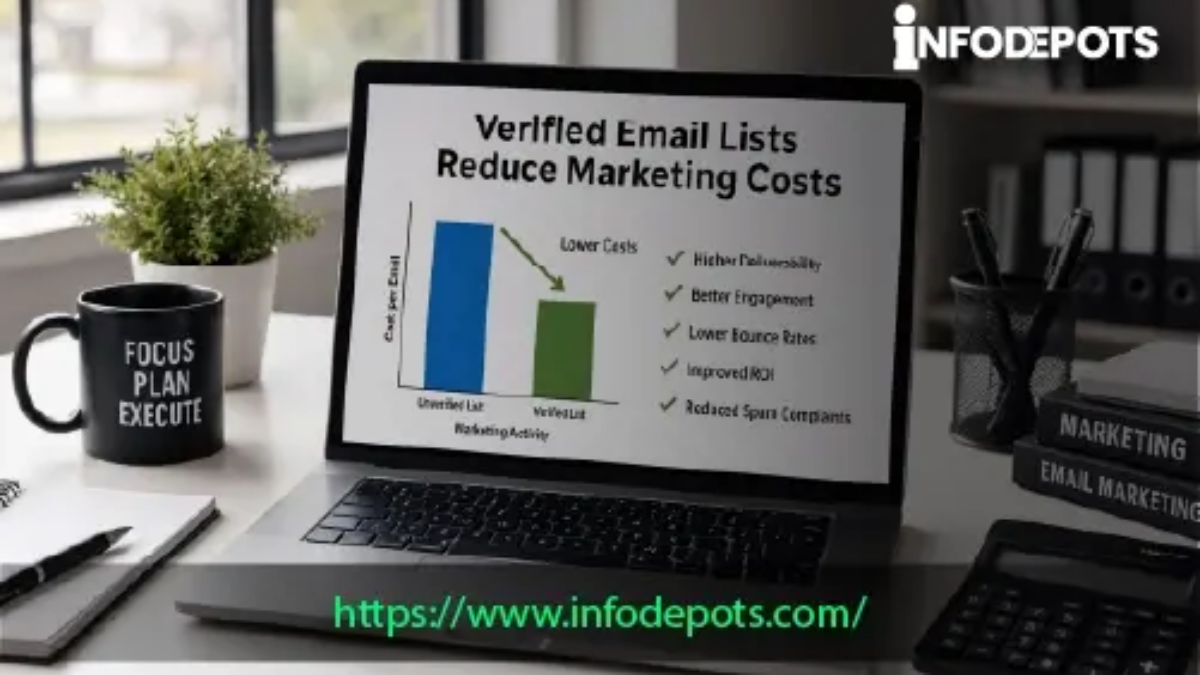
Reduce Marketing Costs with Verified Email Lists, and a lot of that savings never shows up as a line item — it shows up as the campaigns that stopped failing quietly.
Where the Savings Actually Come From
Three places, mainly.
- First, fewer bounces means fewer wasted sends, which is the obvious one.
- Second, better inbox placement means the emails that do go out actually get seen, which raises your effective response rate without you changing a single word of copy.
- Third — and this is the one clients tend to miss — avoiding blacklisting protects the entire domain, not just one campaign. A damaged sender score doesn’t stay contained to the list that caused it. It follows your domain into every future campaign until you rebuild trust with the mailbox providers, and that rebuild takes months, not days.
Think about it this way: would you rather mail 100,000 unverified contacts and get a 40% bounce rate, or mail 60,000 verified contacts and get almost none? The math on the second option wins every time, even though the list is smaller and, on paper, looks like it cost more per name.
The Trade-off Nobody Likes to Talk About
Verified contacts cost more upfront. There’s no getting around that, and I won’t pretend otherwise to make a sale. Verification takes time, infrastructure, and ongoing maintenance — someone has to run the NCOA passes, tele-verify phone-matched records, and strip out the addresses that bounced six months ago but are still sitting in someone’s static file.
So the honest question a client should ask isn’t “which list is cheaper per record.” It’s “which list is cheaper per conversation.” A cheap, stale list often produces a worse cost-per-lead than an expensive, clean one, because you’re paying platform fees, staff time, and reputation risk on top of the wasted sends. Cost-Effective Email Marketing with Verified Contacts Lists isn’t a slogan — it’s just what happens when you stop paying for contacts that were never reachable.
There’s a real trade-off in the other direction too, worth naming honestly: verified lists can be smaller, especially in tight niches. If you need volume for a broad awareness play, a purely verified file might not give you enough reach. In that case, the right move is a blended strategy — verified core list for conversion-focused campaigns, broader reach lists for top-of-funnel awareness where a higher bounce tolerance is acceptable. Treating every campaign the same way is where budgets get wasted.
USA Verified Email Lists and Domestic Compliance
Domestic campaigns carry their own set of cost drivers that international lists don’t. CAN-SPAM compliance, National Change of Address processing, and carrier-level deliverability rules with providers like Comcast or AT&T all shape how a USA list needs to be built and maintained. How USA Verified Email Lists Reduce Marketing Costs comes down to matching a file against current postal and phone records before it ever reaches a campaign manager’s desk — catching the mover, the disconnected line, the retired executive, before the client pays to reach them.
International targeting adds another layer. GDPR-adjacent expectations, regional opt-in norms, and language-specific suppression rules all affect how a list should be verified and segmented. A file built for US B2C outreach doesn’t translate directly to a UK B2B campaign, and treating them the same is a fast way to burn budget on records that were never going to convert in that market.
A Few Examples From the Field
Say a mortgage brokerage buys a refinance-intent list of 50,000 names. If a fifth of those bounce, that’s 10,000 wasted sends before anyone even sees the offer, and the brokerage’s domain reputation takes a hit that follows them into the next campaign too. Compare that to a healthcare staffing firm working a tele-verified list of licensed nurses — smaller list, but every send has a real chance of landing, and the recruiter isn’t burning calendar time chasing dead leads.
Financial advisors prospecting high-net-worth individuals face a similar calculation. A bloated, unverified list of “wealthy households” sounds appealing until you realize half the addresses point to people who moved or passed the account to a different bank two years ago. Reduce Email Marketing Costs by starting smaller and cleaner, then scale the list once the campaign proves it converts.
Where INFO DEPOTS Fits In
This is the part of the process most companies don’t have the infrastructure to do well in-house, and it’s where we come in. INFO DEPOTS runs the NCOA passes, tele-verification, and merge-purge/suppression-clean work that turns a raw contact file into something a sales or marketing team can actually rely on. For B2B files, that includes matching against current SIC and NAICS codes so the targeting reflects a company’s actual industry today, not whatever category it fell into three years ago.
We build and maintain data across a wide range of verticals — healthcare, financial services, insurance, technology, and more — for both US-based campaigns and international outreach, which matters because a list built for one region rarely performs the same way in another without proper localization. For companies expanding into new markets, that regional distinction is often the difference between a campaign that pays for itself and one that adds noise to a domain’s reputation.
The value isn’t that we sell contacts. It’s that we take on the ongoing maintenance work — the part that never stops, because lists decay every single day, whether anyone’s watching or not — so a marketing team can spend its time on strategy instead of chasing bad data.
None of this is complicated in theory. Verified data costs less to run than bad data costs to clean up after. The companies that figure that out early stop treating list quality as an afterthought and start treating it as the foundation the rest of the campaign sits on.
Find Out What Your List Is Actually Worth
If you’re not sure how much of your current list is actually worth mailing, that’s worth finding out before your next campaign, not after. INFO DEPOTS can run a verification pass on your existing file or build a fresh, tele-verified list matched to your target industries and regions, whether you’re targeting the US market or expanding internationally. Reach out us, and we’ll walk through what your data actually looks like right now and what it would take to clean it up.