
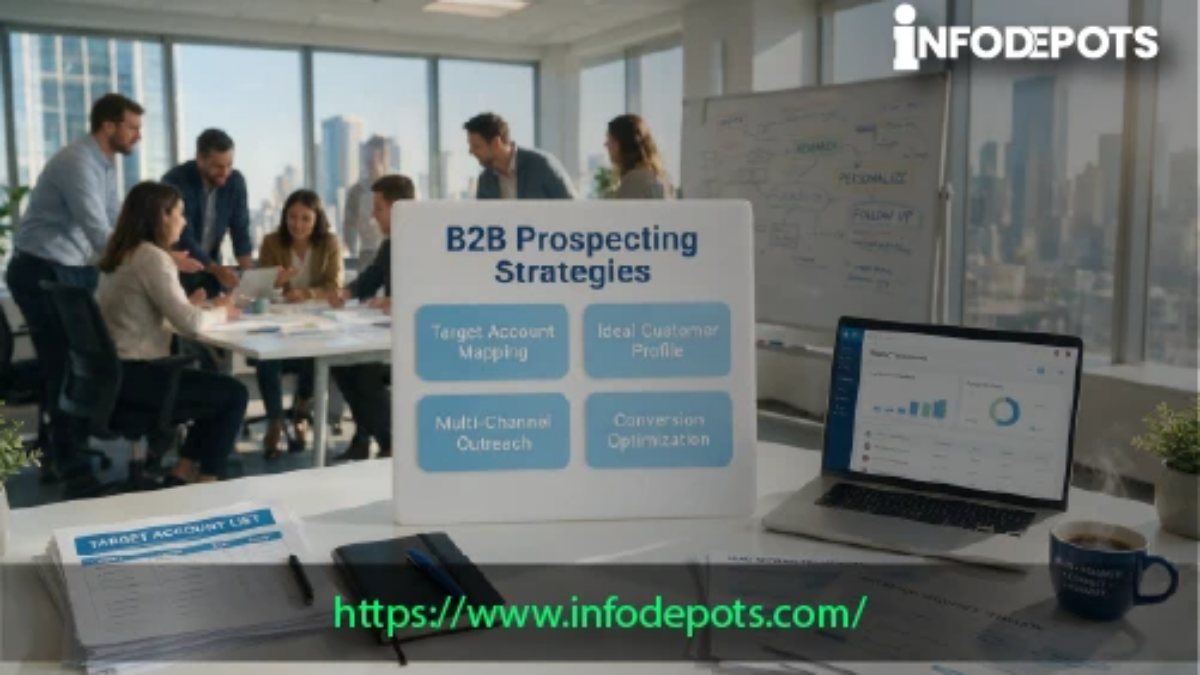
B2B prospecting has changed. A decade ago, a sales representative could build a list, make a few calls, send a standard email, and wait for responses. That approach is much harder to sustain today.
US buyers usually research companies before speaking with a salesperson. They compare vendors, check reviews, examine pricing information, and often form an opinion before the first conversation. In fact, HubSpot’s 2025 sales research found that 91% of sales representatives said prospects already knew about their product before the first call.
That shift changes the job. B2B sales prospecting is no longer about contacting the largest possible number of people. It is about identifying the right accounts, finding the right people, understanding their situation, and approaching them with a useful reason to respond.
Here are the B2B prospecting strategies for US businesses that deserve attention in 2026.
1. Start With an Ideal Customer Profile, Not a Contact List
One of the most common prospecting mistakes is beginning with names and email addresses.
A better approach starts with the business you want to win.
Suppose a cybersecurity company wants to sell compliance software. Its sales team might initially target every technology company in the United States. That sounds ambitious, but it creates a messy pipeline. A 20-person startup and a 5,000-employee healthcare technology company have very different compliance requirements, budgets, buying committees, and sales cycles.
Define the ideal customer using practical criteria such as:
- Industry and sub-industry
- Company size
- Revenue range
- Geographic market
- Technology environment
- Relevant departments
- Job titles involved in purchasing
- Likely business problem
This simple exercise makes every later prospecting decision easier.
2. Use Intent Signals to Decide Who Deserves Attention
Not every prospect should receive the same amount of sales effort.
A company that recently expanded into a new market, hired a senior marketing executive, launched a new product, or opened several locations may have a very different buying situation from an otherwise similar company that has shown no change.
These signals can help sales teams prioritize accounts instead of treating every name on a spreadsheet equally.
For example, imagine a logistics software company notices that a regional distributor has opened seven new warehouses in six months. That expansion could indicate increased operational complexity. A generic pitch about “improving logistics efficiency” is unlikely to stand out. A message discussing warehouse visibility during rapid expansion has a much stronger reason to exist.
This is where CRM activity, company research, website behavior, social activity, and verified B2B marketing lists can work together.
3. Build a Targeted B2B Marketing List
A large database is not automatically a valuable prospecting asset.
A targeted B2B marketing list should help answer three questions:
- Who is the prospect?
- What company does the prospect represent?
- Why might that account be relevant now?
The information required will vary by business. Depending on the campaign, useful fields may include company name, location, industry, employee count, revenue range, job title, department, business email, and other firmographic details.
This is especially important for US sales teams operating across multiple industries or regions. A national campaign can quickly become inefficient when the underlying data contains outdated job titles, duplicate records, irrelevant companies, or contacts who no longer work at the organization.
INFO DEPOTS, for example, can be considered one source when a team needs structured business contact data to support a defined prospecting audience rather than relying on a broad, untargeted database.
The principle is straightforward: build the audience around the sales objective, not the other way around.
4. Treat LinkedIn as a Research Channel, Not Just an Outreach Channel
Social selling is gaining importance, but simply sending connection requests to hundreds of executives is not a strategy.
HubSpot’s 2025 research reported that 42% of sales professionals considered social media the channel with the highest cold-outreach response rate, compared with 26% for email and 23% for phone calls.
The practical lesson is not to abandon email or phone outreach. It is to use channels together.
A representative selling HR software might first notice that the target company’s HR leader has posted about difficulties with employee onboarding. That observation can inform the eventual email or sales conversation. The social channel provided context; the email provided a direct route to the conversation.
That is much more useful than writing, “I noticed you are a leader in HR.”
5. Personalize Around a Business Problem
Personalization is often misunderstood.
Adding someone’s first name to an email is not meaningful personalization. Neither is mentioning the prospect’s company name three times.
Useful personalization explains why the message is relevant to that particular business.
Consider two opening lines:
“Many businesses are looking for ways to improve their sales process.”
versus
“Your expansion into three new states may be putting more pressure on territory coverage and lead qualification.”
The second statement gives the prospect something specific to consider.
That does not mean every email needs to be manually written from scratch. It means the underlying research should influence the message.
A practical framework is:
Observation → Business issue → Relevant solution → Simple next step
Keep the message focused. A prospect should understand quickly why you reached out and what you are proposing.
6. Combine Email, Phone, and Social Touches
One of the better B2B prospecting methods for American businesses is a coordinated sequence rather than a single-channel campaign.
For example:
Day 1: Send a concise email tied to a business issue.
Day 3: Engage with a relevant LinkedIn post or profile update.
Day 5: Make a short phone call.
Day 8: Send a useful follow-up with a specific observation.
Day 12: Make another call or share a relevant resource.
The sequence should not feel like five versions of the same sales pitch.
Each interaction should add something.
Salesforce’s 2026 State of Sales research also points to a broader shift toward combining human selling with AI-assisted sales processes. Its latest report says sales organizations are increasingly using AI agents across activities ranging from prospecting to closing.
That does not eliminate the salesperson. It makes judgment more important. Automation can help identify accounts or summarize research; a salesperson still needs to decide whether the reason for contacting someone is credible.
7. Make Your Email Marketing List Work Harder
An email marketing list should not become a dumping ground for every contact a company has collected.
Segment it.
A software company, for instance, may divide prospects by company size, industry, job function, geography, or stage of the buying process. The message can then reflect the actual circumstances of each group.
A CFO at a mid-market manufacturing company does not necessarily care about the same outcome as an IT director at a healthcare organization.
Also pay attention to email quality. If a mailing list contains large numbers of obsolete addresses or poorly matched contacts, poor engagement can become a symptom of targeting problems rather than a problem with the email copy alone.
For commercial email sent in the United States, compliance matters as well. The Federal Trade Commission says CAN-SPAM applies to commercial messages, including B2B email. Requirements include accurate header information, non-deceptive subject lines, a valid physical postal address, and a clear way for recipients to opt out. Opt-out requests must be honored within 10 business days.
A good prospecting program protects both pipeline quality and sender reputation.
8. Use AI for Research, Not for Thoughtless Mass Outreach
AI can remove some of the tedious work from prospecting. It can summarize company information, identify potential buying signals, organize accounts, assist with research, and help salespeople prepare for calls.
The danger comes when speed becomes the objective.
Imagine a sales development representative using AI to generate 500 nearly identical messages. The team may have created more activity, but it has not necessarily created more opportunities.
A smarter workflow is different:
Research the account → identify the likely problem → use AI to organize information → review the message → add human judgment → send.
This approach also fits Google’s current guidance for content and search. Google emphasizes original, useful, people-first information and warns against creating content primarily to manipulate search rankings. Its May 2026 guidance for generative AI search also stresses valuable, unique, non-commodity content.
The same principle applies to sales outreach: automation should support relevance, not replace it.
9. Measure Meetings and Opportunities, Not Just Activity
A sales team can make thousands of outreach attempts and still have a weak prospecting system.
Track the numbers that reveal what is actually happening.
Look at:
- Positive response rate
- Meetings booked
- Qualified opportunities created
- Opportunity-to-close rate
- Revenue generated by prospecting source
- Time from first contact to opportunity
- Performance by audience segment
Suppose one campaign generates 400 replies but only two qualified opportunities. Another generates 60 replies and 12 qualified opportunities. The second campaign may be far more valuable.
That distinction matters because modern B2B prospecting is a quality problem as much as a volume problem.
What Are the Best B2B Prospecting Strategies for US Sales Teams?
There is no universal winner. The strongest approach usually combines several methods around one well-defined audience.
For a mature sales organization, that could mean a verified B2B marketing list, account research, intent signals, LinkedIn engagement, targeted email, selective calling, and disciplined CRM follow-up.
For a smaller company, fewer channels may work better. A focused list of 200 high-fit accounts can be more useful than 20,000 poorly matched contacts.
The goal is not to contact everyone.
It is to create more relevant sales conversations with the people most likely to benefit from what you offer.
A Practical B2B Prospecting Process for 2026
A useful process can be summarized in six steps:
Define → Identify → Research → Personalize → Engage → Measure
First, define the ideal customer. Next, identify accounts and contacts that match it. Research what is happening inside those accounts. Personalize the reason for reaching out. Engage through the channels your prospects actually use. Finally, measure which activities create qualified pipeline.
This approach is more sustainable than chasing arbitrary outreach quotas.
It also gives sales managers something valuable: a prospecting system they can improve. When results fall, the team can determine whether the problem is audience selection, data quality, messaging, channel choice, follow-up, or qualification.
That is the real advantage of structured B2B sales prospecting. It turns outreach from a daily guessing game into a process that can be tested and refined.
Final Thoughts
The best B2B prospecting techniques for US sales teams are becoming more selective, not more complicated. Buyers have more information, sales teams have more technology, and companies have more data than ever. The competitive advantage comes from using those resources intelligently.
Start with the right accounts. Keep contact data current. Understand the business situation behind each prospect. Use email, phone, and social channels where they make sense. Let AI handle repetitive research without surrendering human judgment.
Most importantly, give prospects a reason to believe the conversation is worth their time.
Turn Better Prospecting Into a Stronger Pipeline
A well-targeted audience gives your sales team a better starting point for every campaign. INFO DEPOTS helps businesses access B2B data that can support focused prospecting, audience segmentation, and outbound marketing initiatives. Instead of building campaigns around broad assumptions, your team can work from defined business and contact criteria that match its goals. Explore the right audience, refine your outreach, and make each sales conversation more purposeful. When better prospecting begins with better targeting, your sales team has a stronger foundation for building qualified opportunities. Get in touch now!